
Automated Pile Layout for Solar Farm Construction
Delivers survey-grade accuracy 3/100′ (8 mm) and lay out up to 3 points a minute




WHY CHOOSE AUTOMATED PILE DRIVING SOLUTION?
Gain 8x Efficiency
1 operator → up to 3,000 points/day
3/100' (8mm) accuracy
Reduce costs by 40% to 50%
Wrap up surveying days faster
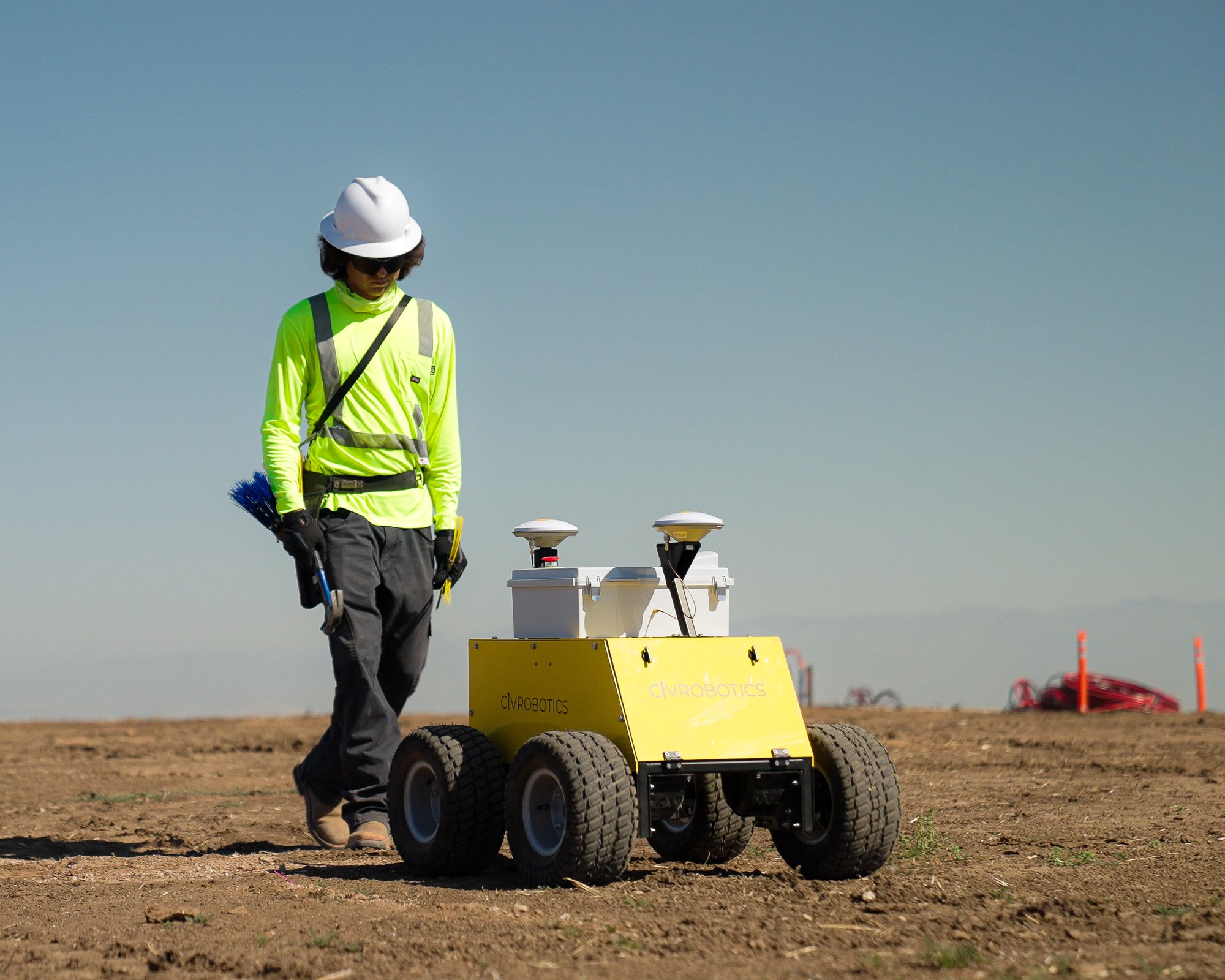
HOW IT WORKS
Anyone Can Operate
Compatible with Trimble, Topcon, Leica
Use with CSV/DXF; exports Topo reports
Works on uneven terrain & in all weather
Shakeout, Piling, Pre-drills, Trenching, Grade checking
"It's fun to use the application and interact with the software. It's a more enjoyable experience for the folks out there doing the work compared to traditional methods."
Zachary Fray
Project Superintendent, Bechtel
"High-Speed Surveying Without the Sweat 💪 Staking out 200–450 points a day manually? Been there, done that. Now, with Civ Robotics, we’re hitting up to 1,000 points per day!
Bringing CivDot into our workflow means faster delivery, better safety outcomes, and way less time spent chasing layouts! "
BamBam Pile Driving
LAY OUT EVERYTHING YOU BUILD
+20GW
SOLAR
+10M
MARKED COORDINATES
+19
STATES
Top Trends Reshaping Solar Farm Construction in 2025
As solar energy capacity expands, technology is transforming how solar farms are designed, built, and deployed. In 2025, automation, AI, and modular construction will play a central role in boosting efficiency, reducing costs, and accelerating project timelines. From machine-controlled earthmoving to AI-driven logistics and robotic solar panel installation, these innovations are streamlining workflows and minimizing reliance on manual labor. Meanwhile, sustainability-driven practices, such as smart material distribution and automated waste reduction, are making solar construction faster, smarter, and more eco-friendly than ever before.
Here’s a look at the top trends shaping solar farm construction in 2025.
Machine Control Automation
Automation continues to transform the solar construction industry, with companies increasingly integrating machine control technology to enhance precision and efficiency. By combining GPS, GNSS, and real-time sensors, companies are reducing rework, optimizing resource allocation, and keeping projects on schedule. As adoption grows, advancements in earthmoving and pile driving will set new standards for productivity and cost savings.
Automated Earthmoving Solar farm construction begins with precise site preparation, and automation is streamlining this critical phase. Traditional grading and leveling require manual surveying and adjustments, often causing delays. With GPS-guided dozers and graders, companies can optimize grading accuracy, reduce material waste, and accelerate timelines.
Benefit: Automated earthmoving minimizes costly rework and fuel consumption, making site preparation faster, more sustainable, and highly efficient.
GPS Pile Driving Pile installation is a labor-intensive process requiring precision and consistency. Machine-controlled pile drivers use real-time GNSS data to ensure precise positioning and depth, reducing errors and improving structural integrity.
Benefit: Robotic pile driving reduces errors, speeds up installation, making large-scale solar projects more efficient.
Unmanned systems
Unmanned systems are revolutionizing solar farm construction by enhancing efficiency, precision, and safety across various phases of development.
Unmanned Ground Vehicles (UGVs) for Precision & Automation UGVs are automating key processes in solar farm development, from site layout to panel installation. Equipped with GPS, RTK, and AI-driven navigation, these robotic systems increase accuracy while reducing reliance on manual labor.
Civ Robotics' autonomous layout solutions streamline site preparation by marking thousands of precise layout points per day, reducing survey time and improving efficiency. AES Corporation’s Maximo utilizes AI-powered robotics to automate solar panel installation, reducing labor needs and improving installation speed and consistency.
Benefit: UGVs improve precision, reduce labor costs, and increase productivity by automating essential site tasks.
Unmanned Aerial Vehicles (UAVs) for Aerial Insights & Monitoring Drones help provide real-time data, improving quality control, and reducing costly errors. Equipped with LiDAR and thermal cameras, drones simplify complex tasks such as site assessments, installation verification, and ongoing maintenance. By capturing high-resolution imagery, they help teams track progress, detect bottlenecks, and ensure projects stay on schedule.
Applications: ✔ Capture aerial overviews to compare progress against schedules. ✔ Monitor hard-to-reach areas for site assessments.
Pre-Assembly, Modular Construction, and Automation for Faster Deployment
As solar farms grow in scale, efficiency in installation is becoming a top priority. In 2025, pre-assembled components, modular systems, and automation will redefine solar deployment by reducing labor costs, optimizing workflows, and accelerating timelines.
Modular and Automated Installation
Pre-assembled racking systems and plug-and-play panels simplify on-site assembly, cutting installation time and manual labor requirements. Terabase Energy’s Terafab automates solar construction with a robotics-assisted digital field factory, integrating digital twin technology and automated assembly lines. Array Technologies and Nextracker, leading solar tracking system providers, are incorporating automated assembly methods to improve installation speed and efficiency.
Benefit: AI-based logistics reduce worker movement by 20-30%, improving workflow efficiency and reducing installation time.
The future of solar farm construction is more efficient, precise, and collaborative. Robots and AI will work alongside the labor force, automating repetitive tasks while enhancing productivity and accuracy. As technology advances, solar farms will be built faster, smarter, and more sustainably, driving the industry toward a new era of efficiency and innovation.
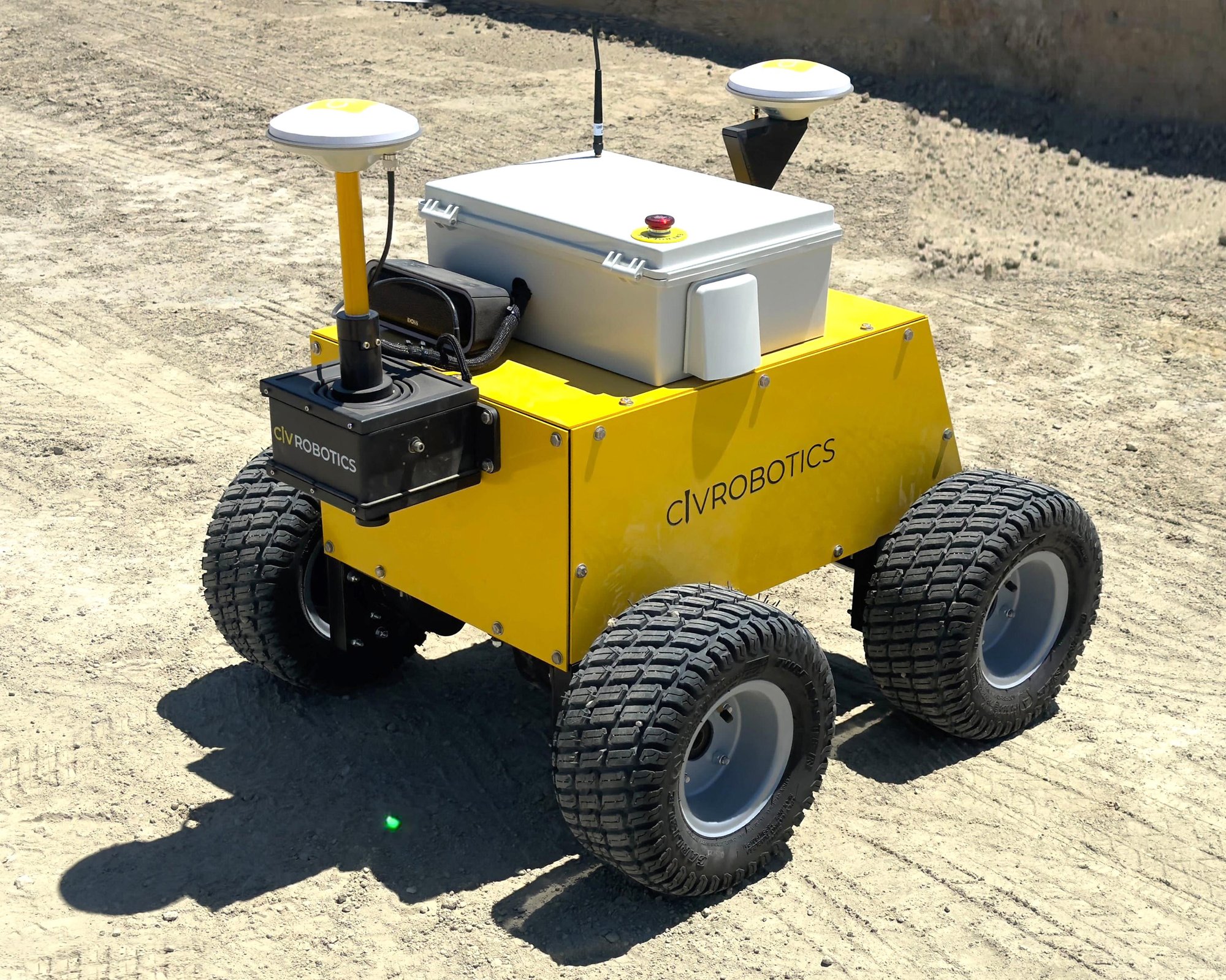
CivDot+ Technical Highlights
Purpose-built for construction automation and precision layout.
|
Feature |
Specification |
|---|---|
|
Precision |
RTK H : 8 mm + 1 ppm / V : 15 mm + 1 ppm |
|
Output rate |
Up to 3 points per minute |
|
Operation |
One-person setup, dual-battery full-day runtime |
|
Connectivity |
Wi-Fi, Bluetooth, LTE, Radio 410–470 MHz |
|
Tolerance |
Pitch & Roll 0.05°, Heading 0.3° |
|
Environment |
-5 °C – 60 °C, 10″ ground clearance, 41 kg weight |
|
Use cases |
Pile layout, ground screws, topo, trenching, QC verification |